
Three phrases turn up on jewelry labels, they all contain the word gold, and they describe three different objects. The price usually tells you which you are looking at, but not always, and the difference decides how the piece behaves after six months rather than on the day it arrives.
Here is what each one is, in the order of how much gold is in it.
Gold plated
A base metal, most often brass, with a thin layer of gold deposited on the outside, usually a fraction of a micron thick. That layer is what you see, and it is what wears. Where a piece rubs, the brass eventually shows: the back of a chain against a collar, the inside of a bracelet clasp, the post of an earring.
The karat number on a plated piece describes the purity of the layer, not the amount of it. A 14K gold plated chain and an 18K gold plated chain differ in color rather than in how long they last; a slightly redder gold against a slightly yellower one.
This is what most of our catalog is, and the reason a chain here costs less than lunch. It is a finish, and it is honest as long as nobody calls it something else.
Gold filled
A thicker layer of gold bonded to a base metal under heat and pressure, rather than deposited. In the US the term has a legal meaning: the gold has to be a stated fraction of the total weight, so the label spells it out as something like 14/20 gold filled.
Practically, it wears far longer than plate, it can be cleaned more confidently, and it costs several times as much. One toggle necklace in our range is gold filled, and the spec table on its page says so.
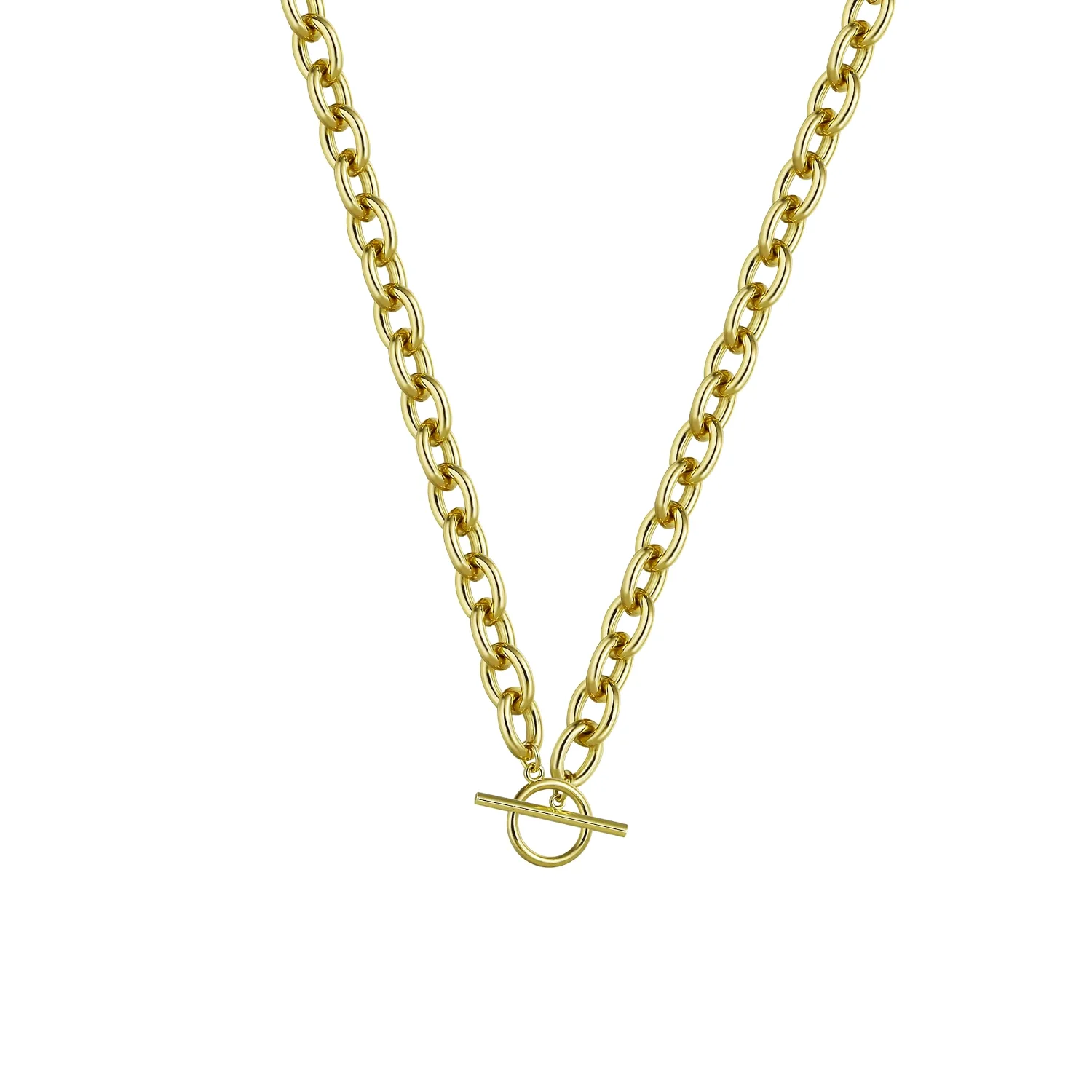
Solid gold
Gold all the way through, alloyed with other metals for hardness and stamped with a karat mark: 10K, 14K, 18K. It does not wear off, because there is no layer to wear off; it scratches and polishes back instead. It also costs what gold costs, which for a chain is a different order of purchase entirely.
Nothing in this catalog is solid gold, and we would rather write that sentence than let a photograph imply otherwise.
| What it says | What it is | How it ages | Rough price for a thin chain |
|---|---|---|---|
| Gold plated | Thin gold layer over brass | Wears through where it rubs | A few dollars |
| Gold filled | Thick bonded gold layer | Years of daily wear | Tens of dollars |
| Solid gold | Gold alloy throughout | Scratches, polishes back | Hundreds |
What to buy for what
For a piece you will wear for a season, or one you are buying to see whether you like a look at all, plated is the sensible answer. For a chain you intend to wear every day for years, gold filled or solid is worth the jump, because a plated chain worn daily is a consumable.
For a gift, the honest version of the question is what you want the person to do with it. A letter pendant on a plated chain is a present they can wear tomorrow. A solid chain is a present they will still own in a decade and will probably wear less.
A note on skin
If jewelry has ever left a red mark on you, the base metal matters more than the gold on top. The American Academy of Dermatology puts nickel allergy at more than 18 percent of people in North America and names surgical-grade stainless steel, 18, 22 or 24 karat yellow gold, pure sterling silver and platinum as the metals to wear instead.
Plated brass is not on that list. Several pieces here are ones we call nickel free, and those say so on the card; if you have reacted before, our page on metals and sensitive skin sets out what to check first.